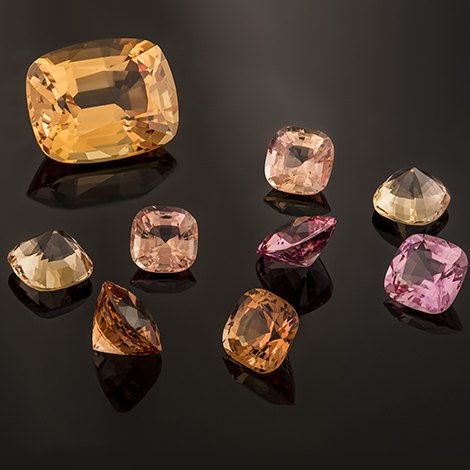
Topaz
- Hardness
- 8
- Refractive index
- 1.619 to 1.627 with birefringence from 0.008 to 0.010
- Specific gravity
- 3.53 to 3.56
Nomenclature
Indicative weight
– carats
| Dimensions (mm) | Weight (ct) |
|---|
All shapes side by side
| Dimensions (mm) | Weight (ct) |
|---|---|
| 2.0 | 0.04 |
| 2.5 | 0.08 |
| 3.0 | 0.13 |
| 3.5 | 0.19 |
| 4.0 | 0.33 |
| 4.5 | 0.40 |
| 5.0 | 0.59 |
| 5.5 | 0.75 |
| 6.0 | 0.98 |
| 7.0 | 1.87 |
| Dimensions (mm) | Weight (ct) |
|---|---|
| 4 × 3 | 0.17 |
| 5 × 3 | 0.27 |
| 6 × 4 | 0.55 |
| 7 × 5 | 0.94 |
| 8 × 6 | 1.39 |
| 9 × 7 | 2.10 |
| 10 × 8 | 2.94 |
| 11 × 9 | 4.11 |
| 12 × 10 | 5.13 |
| 14 × 10 | 6.16 |
| Dimensions (mm) | Weight (ct) |
|---|---|
| 4 × 2 | 0.11 |
| 5 × 2.5 | 0.20 |
| 6 × 3 | 0.31 |
| 8 × 4 | 0.68 |
| 10 × 5 | 1.31 |
| 12 × 6 | 1.98 |
| 15 × 7 | 3.78 |
| 16 × 8 | 4.50 |
| 18 × 9 | 6.73 |
| 20 × 10 | 9.78 |
| Dimensions (mm) | Weight (ct) |
|---|---|
| 3.0 | 0.11 |
| 4.0 | 0.24 |
| 4.5 | 0.43 |
| 5.0 | 0.52 |
| 5.5 | 0.73 |
| 6.0 | 0.87 |
| 7.0 | 1.40 |
| 8.0 | 1.99 |
| 9.0 | 2.74 |
| 10.0 | 4.07 |
| Dimensions (mm) | Weight (ct) |
|---|---|
| 4 × 3 | 0.24 |
| 5 × 3 | 0.32 |
| 6 × 4 | 0.40 |
| 7 × 5 | 1.34 |
| 8 × 6 | 1.96 |
| 9 × 7 | 2.85 |
| 10 × 8 | 4.35 |
| 11 × 9 | 5.94 |
| 12 × 10 | 7.35 |
| 14 × 10 | 7.56 |
| Dimensions (mm) | Weight (ct) |
|---|---|
| 5 × 3 | 0.23 |
| 6 × 4 | 0.45 |
| 7 × 5 | 0.79 |
| 8 × 5 | 1.00 |
| 9 × 6 | 1.60 |
| 10 × 7 | 2.18 |
| 12 × 8 | 3.50 |
| 14 × 9 | 4.92 |
| 15 × 10 | 6.41 |
| 16 × 12 | 9.44 |
| Dimensions (mm) | Weight (ct) |
|---|---|
| 2.0 | 0.05 |
| 2.5 | 0.09 |
| 3.0 | 0.19 |
| 3.5 | 0.25 |
| 4.0 | 0.39 |
| 4.5 | 0.60 |
| 5.0 | 0.71 |
| 5.5 | 0.85 |
| 6.0 | 1.27 |
| 7.0 | 2.07 |
Sources
The main topaz deposits are in Brazil, but very nice topazes can also be found in Madagascar, Myanmar, Mexico, Nigeria, Pakistan, Russia, Sri Lanka and Zimbabwe.
Common treatments
-Heat treatment: most pink topazes are actually heated yellow topazes.
-Irradiation: artificial irradiation will completely change the colour of a topaz to very attractive green, orange, pink or intense yellow shades.
The resulting color is not stable and fades upon exposure to light.
-Irradiation followed by annealing (heat-treatment to stabilise the resulting colour):
most blue topazes on the market are actually very pale blue gemstones turned into “swiss blue” or “london blue” thanks to this stable treatment.
– Diffusion: a stable treatment that turns average pale topazes into attractive green ones.
– Coating: some colorless or very pale topazes can be coated with metal oxides to create the appearance of very colourful gems, or a special effect like in a “mystic” topaz.
Care and cleaning
– Do not leave the topaz under a strong light as the colour may fade.
– Working on topaz requires lots of care as its cleavage can be tricky.
– Be very careful when using ultrasound and steam jets
– Thermal shocks should be avoided
– Impacts should also be avoided as it might break the stone
– Keep away from acidic substances as well.